Session 1
Learning Together in Early-Stage Housing
1. Opening Reflections
This document is both a record and a reflection. It captures what happened in the room during the first session of the LIFT Community of Practice, and it attempts to make sense of what that material tells us about where these housing actors are, what they are up against, and what this CoP needs to become in order to be genuinely useful.
Session 1 was an orientation in the truest sense. Participants arrived carrying their own projects, their own contexts, and their own accumulated frustrations and hopes. The session gave them space to introduce themselves through those experiences, and what surfaced was a surprisingly coherent picture of a sector working hard against structural conditions that are genuinely difficult.
The LIFT Housing Solutions Lab exists precisely because the greatest drop-off in community-led housing happens before feasibility. Projects stall well upstream of design, capital, and formal development pathways. What this session revealed is that the upstream terrain is not just technically complex. It is lonely, confusing, and often demoralizing for the people trying to navigate it.
2. About the LIFT Housing Solutions Lab
LIFT is a CMHC-funded initiative hosted by Paths to Place Society. It tests early-stage pathways for community-led housing and operates across three interconnected streams:
-
The LIFT Program: a time-bound, applied lab that works directly with participating projects at the early stages of development.
-
The Community of Practice: a cohort of housing actors contributing their insights, questions, and experience to build a shared learning community.
-
The Prairie Learning Network: a regional network that supports knowledge transfer and shared insight across a wider geography.
The CoP is not a side feature of LIFT. It is central to the theory of change. If community-based housing providers are to move from aspiration to action, they need more than funding or individual project support. They need a community of peers who understand the terrain, shared knowledge that reduces the cost of learning, and access to the technical expertise that they currently lack.
3. What Happened in Session 1
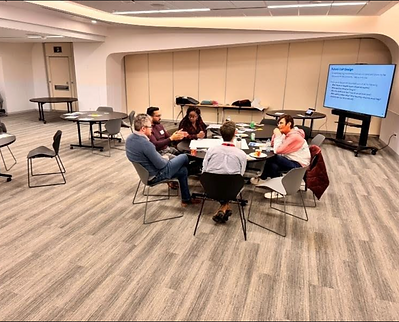
The session used a structured but participatory format. It opened with a visual exploration exercise, moved into small-group peer feedback conversations, and closed with a collective discussion about what the CoP itself should become. Each part surfaced different layers of the same underlying reality.
3.1 Visual Explorer: Futures and Barriers
Participants selected images to represent two
things: the housing future they care about, and a tension or barrier they are currently facing. They discussed their choices in pairs before sharing in the full group. The whiteboard that accumulated from that process was striking.
The vision side was rich and deeply rooted. People named intergenerational housing that actually serves aging in place. They described housing as the root from which everything else in a community grows. They spoke about indigenous ingenuity and cultural foundations, about synergy between different kinds of providers, about the security that stable housing creates for families. These were not generic aspirations. They were specific, felt, and often tied to community and cultural identity in ways that distinguish this group from conventional developers.
The barrier side was equally specific, and the metaphors people chose were telling. Shocked hooves. A swirling storm. A pillar bunging progress. A person on a log without a roadmap. A turtle moving slowly while funding slips away. A chicken-and-egg problem where proof of viability is required before the conditions for viability are in place. These images were not describing mild inconvenience. They were describing structural immobilization. People with genuine purpose, stuck.
What these operators are carrying is not a lack of motivation or vision. It is a gap between what they know how to do and what the housing development system requires of them.
3.2 Challenge Exploration and Peer Feedback
Small groups of four to five participants each shared a specific housing challenge they are currently navigating. After each share, group members asked questions and offered whatever advice they could. The format was intentionally modest: five minutes to share, eight minutes of group response, two minutes to synthesize the feedback received.
What was notable was how quickly the conversations went deep. These are practitioners with real projects and real problems. The peer feedback format worked because the people in the room had enough shared context to ask useful questions, and enough humility about their own knowledge to listen carefully.
The themes that surfaced across groups fell into recognizable categories:
Strategic Clarity
Many participants are wrestling with foundational questions about their own approach. Project versus portfolio. Land versus project as a starting point. What kind of organization they are becoming, and whether their current structure can support what they are trying to build.
Financial Navigation
The financial architecture of community housing development is opaque to many in this group. Where to find equity, how to unlock it, what funding sources exist and how to access them, how to build a business case that works for both funders and community. These are technical questions that require specialized knowledge most participants do not yet have.
The Transition from Service Provider to Developer
This was named explicitly by one participant but resonated across the room. Organizations built around delivering services to people are now being asked to also function as developers. The knowledge gap this creates is not small, and it cannot be closed by individual effort alone.
Government and Systems Navigation
Multiple participants described the confusion of trying to work with government on housing. Not knowing who to talk to. Momentum stopping when the right contact cannot be found. Processes that seem designed for larger, more sophisticated actors.
One participant's image of a person on a log, building without a roadmap, captured something important. These are not people who lack determination. They are people who are making their best guesses in the absence of a map that should exist but does not.
3.3 Co-Designing the CoP
The final portion of the session invited participants to help design what the CoP should become. The input was practical and consistent. Participants want to go deep on applied topics, not just hear presentations. They want access to expertise they currently cannot afford or do not know how to find. And they want the people who are missing from the table, specifically developers, funders, and property managers, to be part of the conversation.
Topics identified as priorities included:
-
The housing development process from early stage through feasibility, translated for community-based operators
-
Financial literacy: equity, funding sources, and building the business case
-
Government relations and systems navigation
-
Modern methods of construction
-
Capacity building oriented toward deliverable-focused work with consultants
4. What This Tells Us: A Candid Assessment
Looking at the full picture of what surfaced in Session 1, a few things stand out that are worth naming directly.
4.1 The Knowledge Gap Is the Core Problem
These operators are not stuck because they lack commitment or community credibility. They are stuck because they are being asked to operate in a development ecosystem that was not built for them, and that assumes a technical knowledge base they have not had access to. The chicken-and-egg problem with OPEP requirements. The confusion about government contacts. The uncertainty about where equity lives. These are all manifestations of the same underlying issue: the gap between community expertise and development expertise has not been bridged for this group.
This is not a personal failure. It is a structural gap. And recognizing it as such matters, because it shapes what the CoP needs to do. The goal is not to fix individual capability deficits. It is to build shared capacity across a community of actors who, together, know far more than any of them does alone.
4.2 The Vision Is Strong and Should Not Be Taken for Granted
The richness of what participants described on the futures side of the whiteboard is worth pausing on. Intergenerational community. Cultural rootedness. Housing as the foundation from which everything else grows. These are not standard developer motivations. They reflect a deep sense of why housing matters that most of the formal development sector does not carry.
That is an asset. It is also fragile. Years of navigating a confusing and often hostile system can erode the sense of purpose that drives this work. The CoP has a role to play in sustaining that vision, not just building technical knowledge.
4.3 The Systemic Barriers Are Real
Several of the barriers named are not problems that capacity building alone can solve. Government processes designed for larger actors. Funding requirements that create impossible sequencing. A policy environment that has not caught up with the reality of community-led housing. These are structural conditions.
The CoP will not fix those conditions directly. But it can help participants navigate them more effectively, and over time, the patterns that emerge across participants’ experiences represent a valuable evidence base. What consistently blocks these operators is data. It has implications beyond this CoP, and it is worth tracking with that in mind.
4.4 Isolation Is a Hidden Cost
One of the less visible things this session surfaced is how isolated many of these operators have been. Working on complex, slow-moving problems without peers who understand the terrain is exhausting in ways that are hard to measure. The energy in the room when people recognized their own experience in someone else’s story was noticeable.
Simply being in a room with others who are navigating similar challenges has value. The CoP does not need to justify its existence purely through knowledge transfer. Community itself, the kind that reduces isolation and sustains motivation, is part of what this space can offer.
5. What the CoP Needs to Become
Based on what Session 1 surfaced, the LIFT CoP has an opportunity to function as more than a learning series. It can serve as transitional infrastructure: the bridge between where these operators are now and where they need to be in order to move housing from vision to reality. That requires being deliberate about a few things.
5.1 A Shared Conceptual Map
Participants are at different points in their understanding and their projects. Before the group can learn together efficiently, it needs a shared vocabulary and a shared map of the development process as it applies to community-based operators. This does not need to be a formal curriculum. But some early sessions oriented around building that common foundation will make everything that follows more productive.
5.2 Bringing the Missing Voices In
Developers, funders, and property managers were identified as missing from the room. Their absence is a gap in the CoP’s ability to serve its participants. These are not just additional perspectives. They represent access to technical expertise and relationship networks that participants currently cannot reach. Finding ways to bring them in, not as presenters talking at the group but as participants in genuine exchange, should be a near-term priority.
5.3 Holding the Structural Picture
As the CoP develops, the patterns that emerge across participants’ challenges should be documented. Not just for internal learning, but as a contribution to the broader evidence base about what enables and what blocks community-led housing. LIFT sits within a CMHC-funded ecosystem with policy implications. The CoP can generate insight that matters beyond the room.
5.4 A Suggested Learning Arc
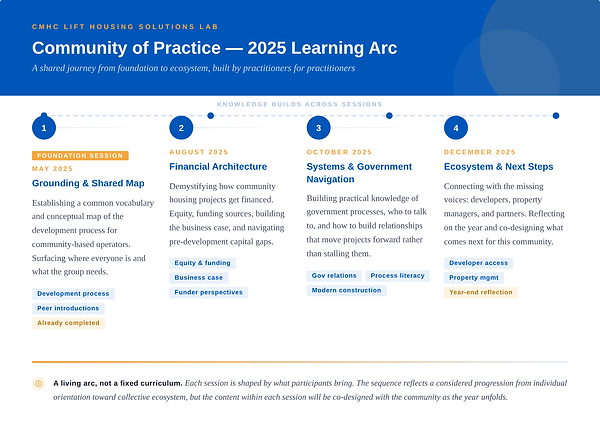
Based on what participants identified, a rough sequence for future sessions might look like this:
-
Foundations: the development process from early stage through feasibility, translated for community-based operators. Building a shared map.
-
Financial architecture: equity, funding sources, the business case. What the numbers need to look like and where to find them.
-
Government navigation: who to talk to, how systems work, how to build relationships with the people who can help.
-
Technical depth: modern methods of construction, property management, contractor relationships.
-
Ecosystem building: structured opportunities to connect with developers, funders, and other partners who are currently missing from the network.
This arc is a starting point, not a prescription. The CoP should continue to be shaped by what participants bring and what they need. The discipline is in holding the arc while staying responsive to what the room surfaces.
6. A Closing Note
Session 1 accomplished something that is easy to underestimate. It established trust. People showed up and were honest about where they are stuck. They offered each other real feedback, not just encouragement. They were specific about what they need.
That is the foundation the CoP needs to do its work. The knowledge building and capacity development that needs to happen is significant, but it will only land in a space where people feel safe enough to say what they do not know. Session 1 created that space.
The work ahead is to build on it. To bring in the expertise and the voices that are missing. To go deep on the things that actually block these operators. And to hold, steadily, the vision that brought everyone to the table in the first place: that housing built by and for community is not only possible, but necessary.